Lumopt
The optical transceiver cost can range widely because two modules that look alike may serve very different links. Data rate, reach, wavelength, optical components, digital signal processing, and temperature rating all affect the price. A short-reach module for a data-center rack is not a fair comparison with a long-reach module designed for demanding transmission conditions. The label alone tells you little.
LightCounting founder and CEO Vladimir Kozlov is known for analyzing optical-component markets. A careful paraphrase of the market lesson reflected in that work is: “Optical pricing depends on the product generation, application, and scale of demand.” This is a paraphrase, not a verbatim quotation. It points to a useful caution: a low unit price may not mean a lower total cost. Compatibility, warranty, qualification, power use, and replacement availability matter too.
The comparison can get messy. Buyers should check the exact part number, supported link distance, connector, and equipment compatibility before weighing vendor quotes. A module listed as “100G” still may not fit a particular port or fiber plant. Small details add up. This guide explains the main factors behind optical transceiver cost, from module type and reach to vendor choice and purchasing volume. It also considers when a lower-cost option is reasonable, and when testing or support deserves more weight. One thing is easy to overlook: the cheapest quote is not always the cheapest working link.
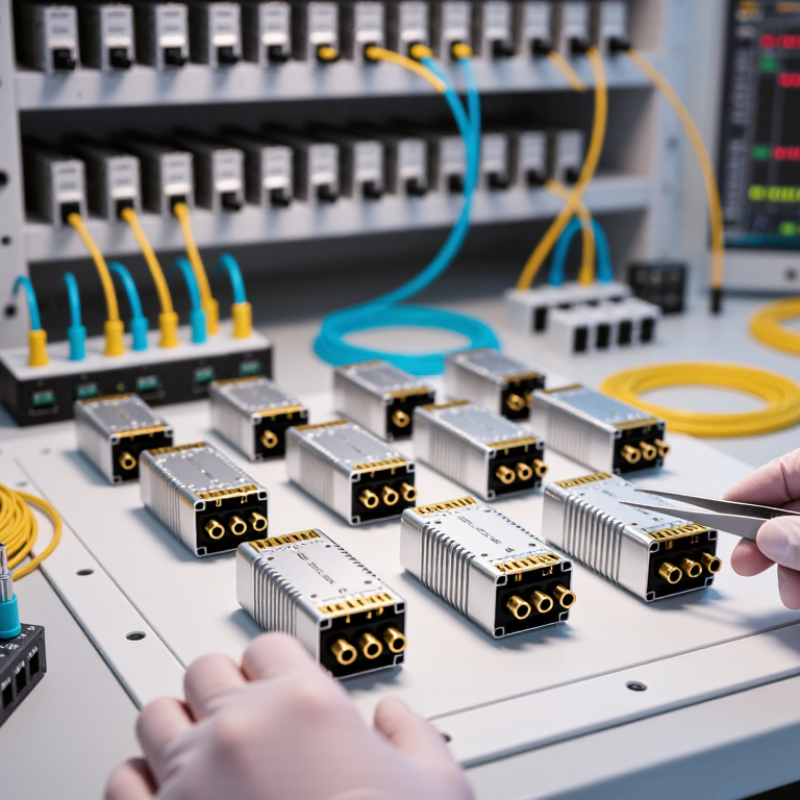
An optical transceiver converts electrical signals into light and back again, allowing network equipment to send data through fiber. It usually plugs into a switch, router, or similar device. Small as it is, its price covers more than the metal housing and optical parts.
The data rate, transmission distance, wavelength, and fiber type all affect cost. A short-reach module for a data center link may use different optics from one designed for a long outdoor route. Inside, the price reflects a laser or light source, a receiver, control circuitry, and thermal management. It converts light. That matters.
A quoted price may also include compatibility checks, firmware or coding, testing, packaging, and a warranty. These details can be easy to overlook. For example, a module that fits physically may still fail to communicate reliably with a particular switch.
Check the supported speed, connector, fiber specification, and operating temperature before comparing offers. There is no single fair price for every transceiver, and a low quote may exclude useful testing or support.
Even experienced buyers can miss a small compatibility detail; checking the equipment documentation is worth the extra minute.
An optical transceiver’s price is not set by data rate alone. The Ethernet Alliance’s 2024 Ethernet Roadmap tracks 400GbE, 800GbE, and 1.6TbE generations, showing how quickly capacity requirements are rising. Higher rates can require more optical lanes, tighter signal control, and more capable digital signal processing. That adds design, testing, and cooling demands. An 800G module may cost more than a 400G module, but not at a fixed multiple; production volume and system compatibility also affect the price.
Reach changes the optical components inside. IEEE 400G specifications include links designed for 100 meters, 500 meters, 2 kilometers, and 10 kilometers. These are different link targets, not equal-cost options: longer spans may need more demanding optics and stricter performance checks. Form factor matters, too. Compact modules must fit within tight space and power limits, while higher-rate designs can generate more heat. Not always. A smaller housing does not automatically mean a cheaper module. The trade-off is easy to underestimate: compare the required reach, host interface, and cooling conditions, not just the rate printed on a product sheet. This comparison is imperfect, since actual prices also shift with supply and order size.
Entry-level optical transceivers usually cost about $10–$50 for 1G and $15–$100 for 10G modules. A 25G unit often falls between $20 and $150, while 100G models range roughly from $50 to $500. These are indicative market prices, not fixed quotations. A short-reach multimode module for a rack connection may sit near the lower end; longer-reach optics, stricter temperature ratings, and verified compatibility can raise the price. Small details matter.
For higher speeds, 400G modules commonly range from about $500 to $2,000, and 800G units can cost $1,500–$5,000 or more. LightCounting’s 2024 Optical Transceiver Market Forecast tracks continued growth in high-speed optics, while the Ethernet Alliance’s 2024 Ethernet Roadmap documents the shift toward 800G interfaces. These reports help explain why newer modules remain costly: faster components and tighter power and thermal requirements add complexity. The quoted bands reflect typical commercial listings and can vary with reach, volume, and testing requirements. They are not a universal benchmark. Budget for spares, too; a cheaper module that fails qualification can become the more expensive choice.
| Data Rate | Transceiver Type | Form Factor | Typical Reach | Typical Price per Module (USD) |
|---|---|---|---|---|
| 1G | 1000BASE-SX | SFP | Up to 550 m over multimode fiber | $5–$20 |
| 1G | 1000BASE-LX | SFP | Up to 10 km over single-mode fiber | $10–$35 |
| 10G | 10GBASE-SR | SFP+ | Up to 300 m over common OM3 multimode fiber | $10–$35 |
| 10G | 10GBASE-LR | SFP+ | Up to 10 km over single-mode fiber | $20–$80 |
| 25G | 25GBASE-SR | SFP28 | Up to 100 m over OM4 multimode fiber | $25–$75 |
| 25G | 25GBASE-LR | SFP28 | Up to 10 km over single-mode fiber | $40–$120 |
| 40G | 40GBASE-SR4 | QSFP+ | Up to 150 m over OM4 multimode fiber | $25–$90 |
| 40G | 40GBASE-LR4 | QSFP+ | Up to 10 km over single-mode fiber | $100–$350 |
| 100G | 100GBASE-SR4 | QSFP28 | Up to 100 m over OM4 multimode fiber | $50–$180 |
| 100G | 100GBASE-CWDM4 | QSFP28 | Up to 2 km over single-mode fiber | $120–$450 |
| 100G | 100GBASE-LR4 | QSFP28 | Up to 10 km over single-mode fiber | $250–$900 |
| 400G | 400GBASE-SR8 | QSFP-DD | Up to 100 m over OM4 multimode fiber | $300–$900 |
| 400G | 400GBASE-DR4 | QSFP-DD | Up to 500 m over single-mode fiber | $600–$1,800 |
| 400G | 400GBASE-FR4 | QSFP-DD | Up to 2 km over single-mode fiber | $1,000–$3,000 |
Prices are indicative per-module street-price ranges in USD. Actual costs vary with order quantity, reach, temperature rating, warranty, coding requirements, and supplier; cables and installation are not included.
An optical transceiver’s price depends on more than its data rate. Compatibility can change the bill quickly. A buyer must match the module to the host port, form factor, wavelength, transmission distance, and fiber type. Digital diagnostics and forward error correction requirements may matter too. A 10-kilometer module is not a safe substitute for a short-reach model just because both support the same speed. Check the equipment’s compatibility records and test the module in the actual port. Paper specifications can miss firmware or thermal limits. That assumption is often too tidy.
Vendor choice adds another layer. Grand View Research estimated the global optical transceiver market at $10.06 billion in 2022 and projected a 15.3% compound annual growth rate through 2030, in its Optical Transceiver Market Size, Share & Trends Analysis report. A growing market brings more options, but not identical quality or support. Compare warranty terms, test documentation, return policies, and lead times alongside unit price. A lower-priced module may require extra validation or troubleshooting. Those hours count. For a large deployment, even a small per-unit difference can become substantial; however, paying more does not guarantee a perfect fit. Procurement teams should verify compatibility before ordering at scale.
An optical transceiver’s purchase price is only part of its lifetime cost. Deployment also requires compatible ports, suitable fiber, patch panels, installation labor, and link testing. A technician may spend extra time cleaning connectors or tracing a mismatched fiber type. That cost is easy to miss in a spreadsheet. Keep spare modules nearby, too; shipping delays can turn a small hardware fault into a longer service interruption.
Power adds a quieter, recurring expense. The U.S. Department of Energy’s 2024 report estimates that U.S. data centers used about 176 terawatt-hours of electricity in 2023, or roughly 4.4% of national use. This is not an optics-only figure, but it shows why per-port power deserves attention at scale. Uptime Institute’s 2024 Annual Outage Analysis found that 54% of respondents’ most recent significant outages cost more than $100,000; 16% exceeded $1 million. Those figures cover outages broadly, not transceiver failures. Still, they underline the value of tested spares and clear replacement procedures.
Tips: Record each module’s power draw, reach, and fiber type before buying. Check connector cleanliness and link levels during installation. Review the results after a few months; real operating conditions may differ from the plan.
Additional deployment, operation, and replacement costs over five years
Illustrative estimates per transceiver, excluding the initial purchase price and network equipment. Energy assumes 3 W of power use, electricity at $0.15 per kWh, and five years of continuous operation. The replacement reserve assumes a 10% replacement rate, a $100 replacement module, and associated labor. Actual costs vary with transceiver type, labor rates, electricity prices, and operating conditions.
It converts electrical signals into light, then converts incoming light back into electrical signals. It connects to network equipment and fiber.
Data rate, transmission distance, wavelength, and fiber type all influence cost. Laser components, receivers, control circuits, and thermal management also contribute.
Indicative prices are $10–$50 for 1G, $15–$100 for 10G, and $20–$150 for 25G. Prices vary by reach and specifications.
Typical ranges are $50–$500 for 100G, $500–$2,000 for 400G, and $1,500–$5,000 or more for 800G. These are not fixed quotes.
One may support longer distances, stricter temperature conditions, or different fiber. Testing and verified compatibility can also raise the price.
Confirm the supported speed, connector, fiber specification, and operating temperature. Check your equipment documentation, too. A small mismatch can disrupt communication.
It may include compatibility checks, firmware coding, testing, packaging, and warranty coverage. Ask what is included; quotes can differ.
Not necessarily. A cheaper module that fails qualification may cost more later. Budget for spare units, though the right quantity is easy to misjudge.
Optical transceiver cost depends on more than the module’s purchase price. An optical transceiver converts electrical signals into optical signals and back, and its price reflects factors such as data rate, transmission reach, wavelength, and form factor. Higher-speed modules and those designed to transmit over longer distances often require more advanced components, while compact designs may have different cost considerations. Prices can therefore vary widely among short-reach, long-reach, and high-capacity transceiver types.
Compatibility and supplier choice also affect pricing, since a module must work with the intended network equipment and specifications. Before purchasing, consider both the initial cost and the expenses of deployment, including installation, testing, and any required supporting components. Ongoing power use, maintenance, spares, and eventual replacement can add to the total over time. Comparing options by performance, compatibility, and lifecycle needs—not just upfront price—helps organizations choose a transceiver that fits their network and budget.
